How many times have you been sitting at your desk wondering, “Why won’t they ___________ ?” Perplexed, you talk with your buddy at work. The conversation goes something like, “I’ve got this person, and I can’t figure out why they won’t ______________.” Or perhaps you talked directly to the person, but after several conversations, they still haven’t done what you asked them to do.
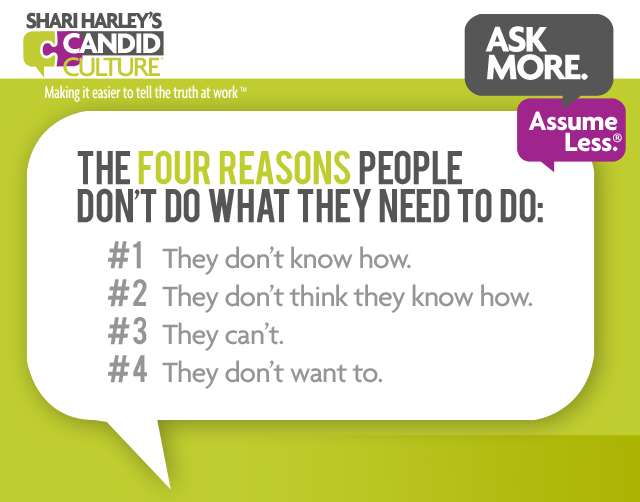
There are four reasons why people don’t do what you ask them to do:
They don’t know how.
They don’t think they know how.
They can’t.
They don’t want to.
Reason number one for a lack of employee performance, they don’t know-how, is the easiest to solve. People who don’t know how to do something need training, coaching, a mentor, a job aid, or some other form of instruction. The hope is that with the right training and exposure, they will be able to do what you’re asking.
Reason number two for a lack of employee performance, they don’t think they know how, can be improved over time with patience and consistent coaching. You aren’t working with clean slates. Most people are recovering from or reacting to a past relationship or situation. If a person worked for a controlling manager who never let them make a decision or worked for someone who invoked punitive consequences for making mistakes, the person will likely be hesitant to make decisions. Hence why they continue to ask questions and repeatedly check in, but never make a decision independently.
If you work with someone who doesn’t think they know what to do, but you know they have the answer, encourage them to trust themself. When they come to you for validation or approval, ask questions, don’t give answers. Tell the person you trust their judgment and encourage risk-taking. Tell them you’ll support their decision, even if it proves to be the wrong one. And encourage them to make a decision next time without consulting you. Then keep your word. If they make a wrong call, you have to have their back and can’t invoke negative consequences.
Reason number three for a lack of employee performance, they can’t, is challenging but clear cut. People who can’t do a task their brains aren’t wired for, will never do that responsibility well, regardless of how much coaching, training, and assistance you provide. If you have repeatedly and effectively, coached, trained, and provided support and the person still can’t do what is being asked, remove that responsibility and give the person something they can do well. If that responsibility is a large part of the job, you have someone in the wrong job. It’s time to make a change.
Reason number four for a lack of employee performance, they don’t want to, is annoying but manageable. There are lots of reasons people don’t do things they don’t want to do. Those reasons include, but aren’t limited to, boredom, lack of buy-in as to why something is important, insufficient time, feeling like a task is beneath them, etc. If you’ve got someone who can but doesn’t want to do something, you can either take the responsibility away, incent them to do it, or give feedback EVERY TIME the task doesn’t get done.
Giving negative feedback isn’t fun for the giver or the receiver. No one wants to hear that they aren’t meeting expectations, and most people don’t want to tell you. But the discomfort of receiving negative feedback EVERY TIME the person doesn’t do what they need to do will create behavior change. They will either begin doing what you ask, quit, or ask for a transfer. Either way, your problem is solved.
The first step in getting people to do what you want them to do is to discover why they’re not doing what you ask. It’s impossible to appropriately manage employee performance if you don’t know why someone isn’t doing what needs to do be done. And the person to ask why a responsibility isn’t getting done isn’t you or your buddy, it’s the person not doing the work. So, get out of your head, leave your office or laptop, and go talk to the person not doing the work.
Here’s how to start an employee performance conversation:
“I’ve noticed you’re not doing ___________. Help me understand what’s happening.” Watch your tone, inquire from a place of genuine curiosity, and identify the reason they aren’t doing what they need to do. Then you can intervene appropriately and hopefully get the behavior you want.
Get the words to say the hardest things in two minutes or less. If you work long enough, you’ll eventually be confronted with these situations. Giving feedback doesn’t have to be hard.
It’s not easy to admit when we’re overwhelmed and need help. In fact, it’s such a hard thing to say that instead of asking for help, most of us either work harder or longer or job hunt. Admitting work overload isn’t a weakness and it isn’t bad. It’s all in how you handle it.
If you find yourself with work overload and you aren’t sure what to do, consider taking these four steps.
Eliminate work overload step one: Every time you find yourself doing something that someone else could and should do, write it down, including how much time the task took. Doing this will create awareness of how much time you spend doing things that may not be the best use of your skills and experience. Then work with whomever you need to in your organization to align that work where it belongs. This practice isn’t to make you sound like an entitled prima donna. It’s an entrepreneurial way to approach your work.
The business owner’s mantra is, “If I can pay someone less than I get paid to do something, I should do that.” Consider how you can apply that practice to your workplace, without appearing to be someone who won’t ‘wash windows.’ Meaning, you don’t want to be or appear to be someone who isn’t willing to do grunt work. Every job has it. But those tasks shouldn’t be where you spend most of your time unless your job description and annual goals say so.
Eliminate work overload step two: Watch out for and eliminate time suckers. This includes people, problems, and processes. If you find yourself in meetings all day long, consider which meetings you don’t really need to attend or send someone else on your team. If someone in your organization calls you daily to have personal conversations, tell the person, “I’d love to talk with you and I’m working under a deadline. Can we catch up later?”
Eliminate work overload step three: Sometimes doing 110% percent isn’t important. Notice when you’re doing more than you need to and when that additional work doesn’t add significant value. I.e., you put together an elaborate PowerPoint presentation and then spent five more hours printing and stuffing folders to mail to coworkers’ homes. Next time, focus on the content and worry less about the aesthetics.
Eliminate work overload step four: Lastly, know when and how to ask for help. The last organization where I worked, before starting Candid Culture, was very fast-paced and lean. I worked all the time and consistently felt overwhelmed. I eventually went to my boss to ask for help. I made a list of everything I was working on and asked him to rate each item based on how important he saw the project/task. He put an “A” next to the things that needed to get done first, a “B” next to the things that came next, and a “C” next to the things that were the least important. He told me to do the A’s first, then the B’s, and if I got to the C’s, great, if not, no problem.
The meeting was eye-opening for me. I assumed he thought everything on my list was an “A” and that left me stressed with an inability to prioritize. Hearing how he perceived my workload reduced my anxiety and gave me permission to ease up on projects I’d previously considered timely.
Don’t suffer in silence. But do approach reducing work overload in a positive way. Rather than whining to your boss and coworkers, end conversations that you know are a time drain, limit work that doesn’t add significant value, and ask for help prioritizing when you can’t do it for yourself.
Unless you never interact with other people, there’s probably someone in your life who repeatedly engages in a behavior that annoys you. You’ve probably made requests about what you’d like the person to do differently, and hopefully you’ve given feedback. But the behavior hasn’t changed.
At some point, we have to accept that people are who and how they are. People can and will change certain behaviors, if their motivation is high enough. But other behaviors won’t change, and if you want to have the person in your personal or professional life, you have to accept the behavior and the person as they are. Accepting frustrating behaviors can be very difficult, at least it is for me. I admit, I often have this conversation myself, “Why won’t they…? I don’t get it. It’s not that hard. How many times do I have to ask?”
Here are five strategies for working with difficult people:
Working with difficult people strategy one: Decide on the behaviors you absolutely must have from others. We want certain things. We need other things. Get clear on what you need.
Working with difficult people strategy two: Make requests before breakdowns occur. It’s always easier to make requests than to offer negative feedback. Be sure you are being explicitly clear in your requests. For example, “Please include me in meetings” is too vague. Instead, try, “Please invite me to all client meetings, so I can stay connected to clients and projects.”
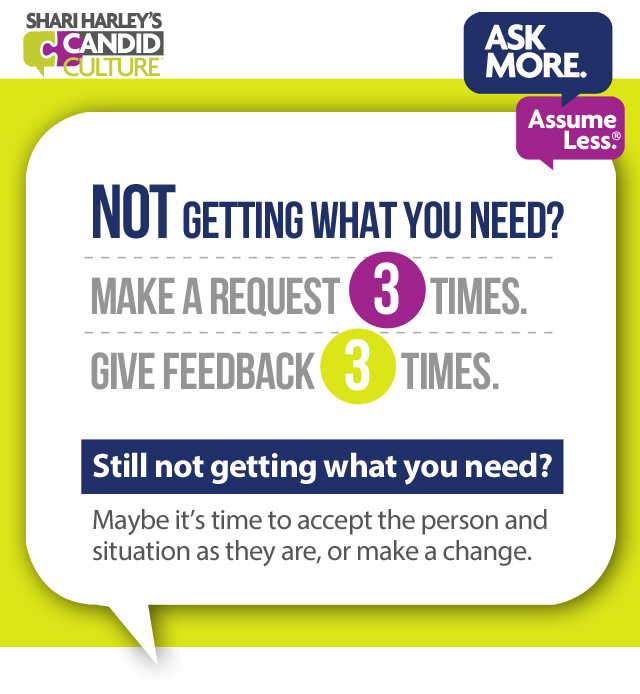
Working with difficult people strategy three: Make requests at least three times. With each successive request (nicely) remind the person that you’ve made this request in the past and it still isn’t happening. For example, “We’ve talked about this in the past. Help me understand what’s happening.”
Working with difficult people strategy four: If you’ve made a request at least three times, give feedback as to what isn’t happening and why that causes challenges. For example, “We’ve talked about inviting me to client meetings a few times. It’s still not happening. I’m getting calls from clients with questions I can’t answer because I’m not included in the meetings. Can you help me understand why I’m not being invited to meetings?” Read chapters nine through eleven and chapter thirteen of How to Say Anything to Anyone to get more examples of how to give clear and specific feedback.
Working with difficult people strategy five: Know when to give up and accept the person and behavior as they are. If you’ve made a request and have given feedback three or four times, you likely aren’t going to get what you want. The person either can’t do what you’re asking or doesn’t want to. Now you have a decision to make.
Decide how important the behavior is. Is it a deal breaker? If it’s not a deal breaker, stop expecting the behavior to happen and accept that it won’t. When you accept that you won’t get what you want from someone, you’ll suffer less.
Strategy five is really the crux of this blog. Knowing when to stop expecting something and coming to peace with that decision will give you great freedom. In order to let go of the expectation, you have to decide that it’s really ok for you not to get what you want. Ask yourself, “Can I live with this behavior as it is?” If you can’t, you have a hard decision to make. If you can, then stop expecting and asking for the behavior; you’ll feel better.
Avoiding having difficult conversations because you’re uncomfortable? Afraid you’ll hurt someone’s feelings? Worried you’ll damage your relationship? Why not just say so?
The people you work with want to work with other human beings. And part of being human is expressing how you feel.
It may seem that admitting that you’re nervous or uncomfortable weakens your position and diminishes your power. This couldn’t be further from the truth. Saying how you feel and being willing to be vulnerable are signs of strength. People with strong egos can admit when they are uncomfortable, people with weak egos feel too threatened to do so. Vulnerability and authenticity help other people see you as human, and make people feel closer to you. And people want to work with other human beings, not emotionless androids who never show their cards.
If you’re nervous, say you’re nervous. If you’re afraid you’ll negatively impact your relationship by speaking up, say so. If you’re not sure it’s your place to raise an issue, say that. You won’t lose anything by stating your concerns. You only stand to gain.
Starting difficult conversations could sound like this:
Having difficult conversationsoption one: “I’m not sure it’s my place to talk about our department’s Customer Service Survey results, but I care about our reputation and have a few thoughts. Is it ok if I talk about them with you?”
Having difficult conversations option two: “I’ve got some input that I’ve been hesitant to share, but I think the information could be helpful to you. I care about you and your career, and I want you to be successful. Is it ok if I share my thoughts?”
Having difficult conversations option three: “I’ve got a few things to talk with you about, but haven’t brought them up because I’m a bit concerned about how you’ll react. Is it ok if I share them with you? I’m saying these things because I care about our department, and I’m noticing a few things I think we can do differently, for better results.”
You probably noticed that in the examples above, I stated that I was concerned about speaking up, asked for permission to do so, and stated the reason I wanted to provide input. Your motive for having difficult conversations is very important. When people trust your motives, you can say anything. When they don’t trust your motives, you can say little.
Don’t be afraid to say how you feel. If you’re afraid to speak up, saying so won’t reduce your credibility, it will likely increase it. State your concerns, explain why you’re speaking, and ask for permission to give feedback. Doing those three things will help any message be well received and is likely to make it easier for you to say what you want to say.
As crazy as it sounds, it can be difficult to get work done at work. There are the drive bys – people who want your opinion on EVERYTHING before they make decisions, the interrupters who have just one question, several times a day, the visitors who want to update you on EVERYTHING happening in their personal lives, and coworkers who host meetings at their workstation, take phone calls on speaker phone, and who listen to music without headphones, while loudly eating potato chips. All of these distractions are enough to make many employees want to find a quieter place to work.
The concept that it can be hard to get work done at work is crazy. We’re at work to work. And yet many employees, with and without a door, get in at 7:00 am, before others arrive, so they can “get some work done” and stay late because they “got nothing done all day.”
Open work environments can be productive and interruptions can be minimized, but managing interruptions at work will require some clear guidelines and direct communication, which many workplaces are missing.
Managing interruptions at work – practices for creating a work environment that works for everyone:
Write workspace practices down, share them with all employees, post the practices in every work area, and discuss them frequently.
Examples of practices for managing interruptions at work:
Use a headset for all phone calls.
Pay attention to your volume. Speak as quietly as possible.
If you have visitors at your desk for business or non-business related conversations that last longer than five minutes, take the conversation to a conference room, empty office, or local coffee shop.
Use headphones to watch videos and listen to music.
Avoid prairie dogging—calling down a row, hallway, or over a cubicle wall. Instead, walk to the person’s desk, call, or send an email or text message.
Turn off all auditory alerts on computers and cell phones, so your coworkers don’t have to hear pinging and ringing all day. The people you sit with don’t need to know every time you receive an email, text, or Facebook message.
Finally, but MOST IMPORTANTLY, give all employees permission to make requests and give feedback when workspace guidelines are broken. It must not only be acceptable but expected that employees will say something when a guideline is broken and the workspace gets too loud.
Most employees will not speak up when others are being loud. It’s easier to find another location to work than risk a coworker’s defensive response. And no one wants to be ‘that person’ who complains about how loud someone is. If employees aren’t comfortable speaking up and making requests, offer training on how to have these conversations, and provide written examples of what employees can say that is respectful and clear.
Guidelines for dealing with interruptions at work:
You’d think that having a door would make people immune to workplace distractions, but that’s not the case. Employees with offices also deal with drivebys and interruptions. The key to dealing with both is communication.
Don’t wait for problems to occur. Anticipate challenges and talk about them before guidelines are broken. It’s much easier to make a request than to give feedback.
Each time a new person joins a team, department, or workspace, ask everyone on the team to share their work-related pet peeves, how they like to communicate, and how they prefer to be interrupted. Everyone deals with interruptions, so you might as well express a preference. If you’d prefer people email you to ask when you have time for a quick question, make that request. If you’re ok with people interrupting you without notice, let people know. If you’re not distracted by noise, tell people. If you are, make that preference known.
People are too hesitant to speak up at work for fear of damaging relationships and hurting people’s feelings. The best thing leaders can do to improve the working environment (or any workplace challenge) is to set clear expectations, create opportunities to talk about how things are going, and make it ok to speak up. Suffering at work is optional. Everyone is accountable for the work environment, and you won’t get what you don’t ask for.
It’s normal to want things but do things that prevent us from getting those things.
I want to get more sleep, but I lie in bed playing with my iphone long after I should be asleep. I want to be in better shape, but I find every reason not to work out. I want to do more local work, but I don’t pursue work in Denver. Who in Colorado wants to hire me to speak or do some training? Ok, back on track.
To have something different, we need to do something different, and that often means giving something up. Letting go of a habit or pattern is challenging. There’s a reason we do what we do. Our habits provide something – comfort, distraction, fun, etc. If you’ve ever done a ropes course or graduated to a more challenging ski run, you know you need to let go of what feels secure to get to the next level. And letting go can be scary and difficult. But if we don’t let go, we get stuck where we are.
Make a list of things you want that you don’t have now. Perhaps you want to:
Learn a new skill or take on a new responsibility at work
Buy a house
Save more money
Be in better shape
Pursue a hobby
Then I’d ask, what do you need to give up (aka stop doing) to have what you want?
You need to do something differently, or you would already have what you want. Doing something differently could be as simple as telling someone who can help you get what you want. We often tell our coworkers and friends what we want from our job, but we don’t always tell the people who can help us get what we want.
If you want a different job, tell someone in your organization who can help you get what you want. Then create a plan with actions you’ll take, milestones, dates, and measurable outcomes, and follow up until you attain your goal.
Lastly, accept when you can’t get what you want from a person or organization, grieve, and then make a big change. If you have consistently pursued a role in your organization and in two or three years haven’t moved toward that goal, chances are you won’t get that job at that company. It’s likely you need to leave.
Choosing to leave is often the most difficult decision to make. We work and work on a relationship or situation, and eventually realize, we will never get what we want. That’s a very hard pill to swallow. But if you’re certain you won’t get what you want, despite your efforts, move on.
Five Steps to Reaching Your Goals – Ask Yourself:
What do I want that I don’t have now?
What do I need to give up in order to have what I want?
Have I made a request of the person/people who can help me get what I want?
Can the person/people I’ve asked for help assist me, and do they want to do so?
With persistence and consistency, can I get what I want from this situation, or is it time to move on?
Keys to reaching your goals: Determine what you want; tell someone who can help you get what you want; be consistent and persistent and be ready to make changes. To have something different, we have to do something different.
If you work with other people, there is likely at least one business relationship you wish was stronger. If only that person included you on necessary communications, didn’t gossip about you, or gave you honest feedback, versus telling you everything is fine and then working around you.
What often makes work hard isn’t the work at hand, it’s the people we work with – the power struggles, cc-reply-to-all when everyone doesn’t need to know, and the gossip that pervades most organizations.
You need to communicate and work well with the people you work with. And like any relationship, business relationships require work. But what happens when someone doesn’t return your efforts for a positive working relationship? They don’t return emails or voicemails, ignores requests, or goes above you instead of coming to you when issues arise?
Make three attempts at strengthening a business relationship.
I’ll attempt to strengthen a business relationship three times before giving up. Phone calls, video, and in-person meetings count as an attempt to improve a relationship, emails and text messages don’t. Emails and texts are passive, one-sided communications. If you’re serious about strengthening a relationship, talk with the person, either in person or via video or the phone.
The conversation could go something like, “We’re going to be working together a lot this quarter, I thought it would be helpful to talk through how we both like to communicate and who will do what. When is a good time for us to connect via phone?”
Or, you could say, “A lot has happened this year – good and bad. I thought it would be helpful to talk about what did and didn’t work, so the rest of the year is smooth. Can we schedule a call to talk about it?”
Or, perhaps, “I want to talk with you about how we work together. I think we both know that this year has been hard. I’d love for us to have a good working relationship. Can we talk about how we want to work together going forward?”
I’ll make attempts like those above three times (with the same person). If the person doesn’t reach back, says no, or cancels three scheduled meetings, I give up. Don’t chase people. The people who are interested in fostering a good working relationship will make the time and be willing to be uncomfortable.
What does it mean to give up? You are not the Golden Retriever of the workplace. Nor are you the 7-11 – always open. If someone isn’t interested in talking with me about how we can improve our relationship, I don’t keep asking. After the third no, I’m polite. I include the person in all necessary meetings and communications. I’m professional. But I don’t keep inviting. You can’t work with someone who won’t work with you.
Extend an olive branch. Be forthcoming, brave, and yourself. And if you get three nos’, work on other business relationships and leave this one be.
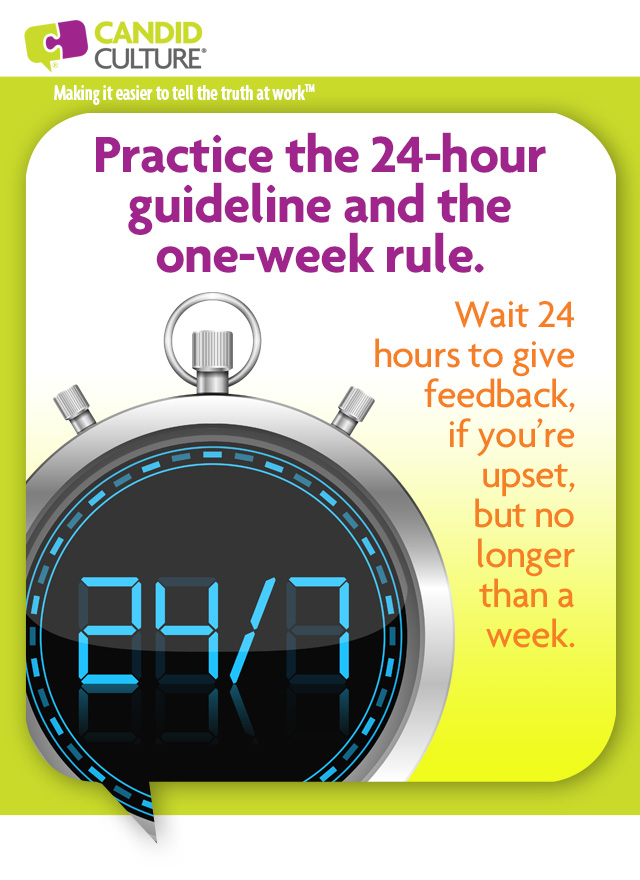
Most of us wait to give negative feedback until it’s the right time, aka the recipient won’t get upset. Or we wait, hoping the situation will resolve itself. If something is really an issue, the likelihood of either happening is pretty slim. The right time to give feedback is shortly after something happens. I’ll offer up the 24-guideline and the one-week rule. Wait 24-hours to give feedback, if you’re upset. But don’t wait longer than a week.
The purpose of giving positive or negative feedback (I like the word upgrade feedback) is to motivate someone to replicate or change a behavior. That’s it. Feedback is supposed to be helpful. If you wait longer than a week to give either positive or upgrade feedback, the person isn’t likely to remember the situation you’re referencing, and the purpose of giving feedback – to change or replicate a behavior – will be lost.
Here are four practices to make negative (upgrade) feedback conversations shorter, less painful, and more useful:
Giving feedback practice one: Agree to give and receive feedback at the onset of relationships. Do this with everyone you work with – direct supervisors, direct reports, peers, internal and external customers, and vendors.
Giving feedback practice two: Prepare for feedback conversations by writing down what you plan to say and then delivering the feedback to a neutral person. Ask that person to tell you what they heard and what their expectations would be, based on what you said. Confide in someone either at your level or above at work or someone outside of work, to keep the gossip to a minimum. Ask for confidentiality.
Giving feedback practice three: Tell a neutral person about your situation, and ask what they would say to address the situation. Everyone but you will do a better job at giving feedback. Feedback conversations become hard when we’re emotionally involved. The guy working at the 7-11 will do a better job than you. Seriously. It’s our emotions and concern about the other person’s reaction that makes feedback conversations challenging.
Giving feedback practice four: Agree to do a weekly debrief with the people you work closely with, and follow-through. Answer the questions – what went well this week from a work perspective and what would we do differently if we could? Answer the same questions about your working relationship. Giving feedback about your relationship will be hard at first. It will be easier the more you do it. Be sure to say “thank you” for the feedback, regardless of what you really want to say. One of the reasons giving negative feedback is so hard is we wait too long. Shorter, more frequent conversations are better than long, infrequent discussions.
Giving negative feedback doesn’t have to be so hard. Follow the suggestions above and remind yourself that the purpose of giving feedback is to be helpful. If you were doing the wrong work, you’d want to know. And others do too.
Years ago, a guy I was dating asked, “We don’t really need to do anything for Valentine’s Day, do we?” I was taken aback by his question (which was really a statement) and replied, “No, we don’t.” But I didn’t mean it. And when he blew off the ‘holiday’, I was furious and let him know it. Instead of having dinner on Valentine’s Day, we had an ugly conversation and a lousy rest of the week. Asking for what I wanted upfront would have been much less painful.
Why is it so hard to ask for what we want, especially from the people who love us? Learn how to get what you want on Valentine’s Day and every day.
We aren’t likely to get what we don’t ask for. The people in our lives can’t read our minds. They don’t know what we want. This is true at home and at work. If you want a report to look a certain way, sketch it out for your employees. If you want a meeting handled in a certain fashion, give detailed instructions. For the most part, we expect things to go well and thus we delegate insufficiently at work and hope to be pleasantly surprised at home.
I hope the people who love you are intuitive enough to give your heart what it wants on Valentine’s Day, and every day. But if they don’t, make it easy for them to please you by telling them what you want. For example, tell the person you love, “I’d love to spend the day together. I don’t care what we do, as long as we’re together.” Or, “I don’t care what you do for Valentine’s Day, but please do something to mark the day.” And if you want something specific, ask for it. “I’d love flowers, despite that they’ll die and are impractical. Anything but roses and carnations would be lovely.”